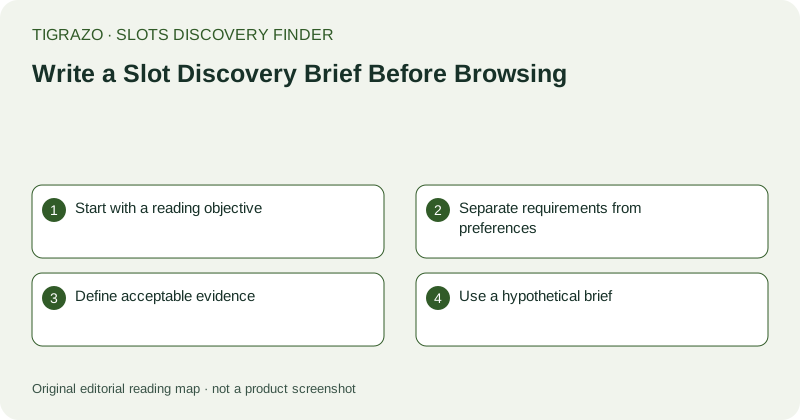
Start with a reading objective
Write one sentence describing what you want to understand. For example, you might want to compare how three-reel and five-reel layouts present qualifying matches, or locate games whose information panels explain every multiplier. An objective gives the search boundaries. Avoid beginning with a promise such as finding a game that pays regularly enough to recover losses. Discovery can identify documented characteristics, but it cannot manufacture predictable returns. A useful brief remains valid even when it produces no acceptable candidates and no paid action follows.
Separate requirements from preferences
Requirements are conditions a candidate must satisfy for your research purpose. These could include a readable paytable, explicit stake units and a clear way to stop automatic play where that function exists. Preferences might include a particular visual style or a compact layout. Keep those lists separate so an attractive theme cannot compensate for missing cost information. Also distinguish a required capability from your preferred implementation: adjustable sound is a capability, while placing its control in a particular corner is merely one possible design.
Define acceptable evidence
For each requirement, decide what would establish it. A layout needs a documented grid or clear rule diagram; a sound preference needs an actual control or an explicit explanation of it. A promotional tag is only a lead. Your brief should say whether direct inspection, written instructions or both are necessary. If information is ambiguous, use unresolved rather than yes. This avoids quietly changing your evidence standard when a candidate happens to look appealing or when one detail is inconvenient to verify.
Use a hypothetical brief
A hypothetical research brief could read: identify up to three fixed-layout formats with explicit award direction, legible stake controls and independently adjustable audio. Essential checks are format, minimum match and cost visibility. Optional preferences are restrained animation and a compact information panel. Exclusions are unclear multiplier units and controls that obscure the selected stake. The purpose is to practise rule reading, not to estimate earnings. This example is deliberately bounded: it describes the evidence sought without inventing candidate titles, scores, prices or actual availability.
Set a stopping rule for the search
Give browsing a time or candidate limit and decide what happens if evidence remains missing. You might stop after reviewing five information panels and retain only documented matches. Do not expand the brief indefinitely to justify more searching. Keep the final output small: requirement, evidence, uncertainty and disposition. A discovery brief succeeds when it explains why something was included, excluded or left unresolved. It does not need a winner, a recommendation to wager or a claim that one set of preferences suits everybody.