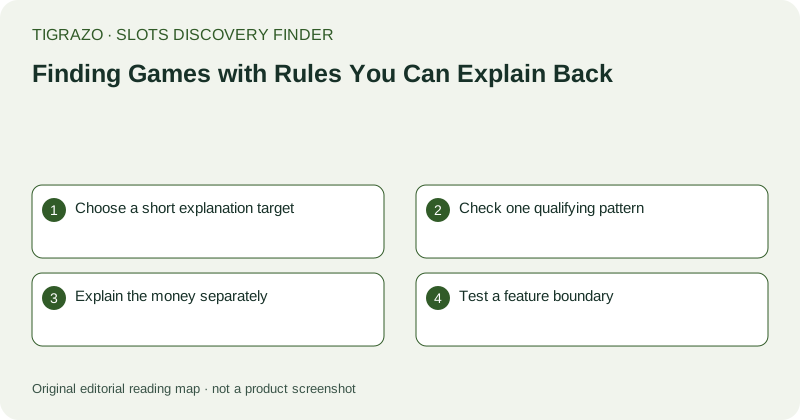
Choose a short explanation target
Ask whether you can describe a normal round in five sentences: what is staked, which positions count, what makes an award, what special symbols do and how the result settles. You do not need to memorise every payout amount. The aim is to understand the structure well enough to locate details when needed. If your explanation relies on phrases such as it works like other games, pause. Familiarity with another title is not evidence that this one uses the same rules or units.
Check one qualifying pattern
Choose a documented example or construct a clearly hypothetical pattern from the written rules. Explain why it qualifies and identify the paytable entry that would apply. Then change one condition, such as removing the symbol on the first reel or breaking a cluster connection. Can you explain why the result changes? This contrast tests comprehension more effectively than repeating a definition. It also exposes missing direction rules, unclear minimum counts and uncertainty about whether a symbol substitutes for the one being evaluated.
Explain the money separately
A candidate may have clear symbol rules but unclear payout units. Find whether awards refer to total stake, line stake, coins or already converted currency. In a hypothetical total-stake example, five times 0.20 equals 1.00. The same multiplier applied to a different base means something else. Your explain-back should name that base explicitly and distinguish payout from net balance change. If you cannot do that, mark cost interpretation unresolved rather than assuming a familiar-looking number means the same thing everywhere.
Test a feature boundary
Select one bonus or special rule and identify its beginning and end. State the trigger, initial conditions, any persistent change and stopping rule. If a multiplier increases, explain when it changes and what it multiplies. If a feature can retrigger, find the precise condition rather than assuming the base-game trigger applies unchanged. You are not trying to estimate whether the feature is generous. You are checking whether the description contains enough information to trace its sequence without guessing about timing or settlement.
Record clarity as evidence
Use three outcomes: explainable, partly explained and not established. Attach the unclear sentence or missing condition to any unresolved result. Do not turn a comprehension difficulty into an unsupported accusation that a game is defective; the gap might reflect terminology, presentation or incomplete information. Equally, do not overlook the gap because the theme is attractive. A candidate can remain outside a shortlist until the rule is clarified. The discovery result is stronger when it preserves uncertainty than when it forces every candidate into a confident verdict.