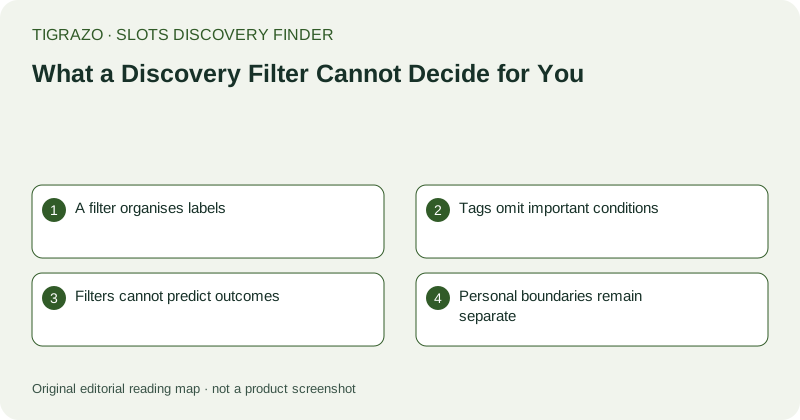
A filter organises labels
A filter generally selects entries associated with a category. It does not necessarily verify that the category is complete, current or defined consistently. A tag for wilds might cover several very different substitution rules. A cluster label may not explain adjacency or minimum size. Treat the result as a set of leads rather than a set of proven matches. Your next task is to read the relevant rules and decide whether each candidate actually satisfies the specific requirement written in your discovery brief.
Tags omit important conditions
A feature can exist only in a bonus, only under certain modes or only with documented restrictions. A filter may not communicate those boundaries. Likewise, a sound-control tag might not distinguish one master toggle from independent music and effect settings. Write the condition that matters to you and verify it directly. The more specific the requirement, the less likely a broad label is to settle it alone. An attractive match count should not pressure you to lower the evidence standard or overlook an exception.
Filters cannot predict outcomes
Choosing a particular theme, layout or feature category does not create a winning system. Even a filter using an RTP figure cannot promise a session return. RTP concerns long-run expected return over wager volume and depends on the applicable configuration. Hit frequency is different, and neither establishes that an award is due. A filter cannot determine how your next spin will settle or ensure that a series of purchases returns its cost. Those are mathematical limits, not shortcomings that a more detailed catalogue can eliminate.
Personal boundaries remain separate
No collection of matching features can decide whether spending time or money fits your own limits. A candidate can satisfy every research criterion while still requiring no action at all. Keep time and spending boundaries outside the filtering process so they do not shift when a new tag looks appealing. Nor can a general accessibility label decide whether all your access needs are met. That question depends on specific tasks, devices and capabilities, and may remain unresolved after a catalogue has narrowed the field.
Use filters within a complete route
A sound route is brief, filter, verify, record and stop. The brief defines the question; filtering reduces the search space; verification checks the evidence; recording preserves conditions and uncertainty. Stopping prevents endless refinement from becoming its own objective. A final record might contain a partial match or no match, and both are legitimate. The filter's job is modest but useful: it helps locate information. It should not be promoted into an authority on game quality, personal suitability, expected session results or whether any paid action should follow.