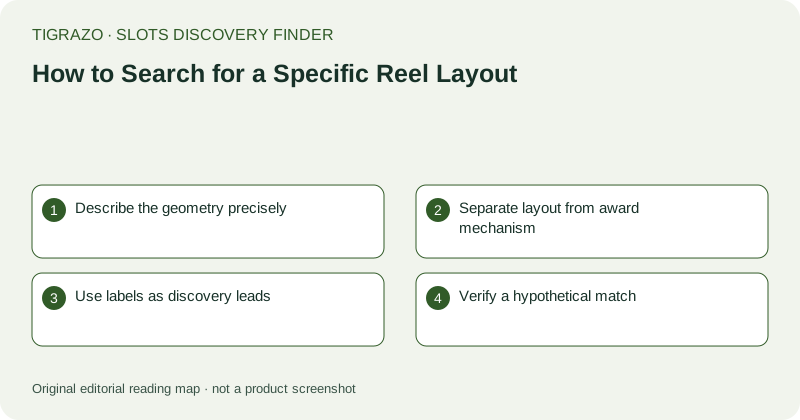
Describe the geometry precisely
Write the arrangement in plain language before searching. Five reels with three visible positions each is clearer than a vague request for a standard slot. If reel heights vary, record the sequence or state that the number of positions changes. Distinguish the visible grid from the number of active positions used in evaluation. Decorative symbols, framing and background panels are not necessarily part of the playable layout. Precision here helps you compare information rather than merely matching images that look broadly similar.
Separate layout from award mechanism
The same five-by-three arrangement can support different evaluation rules. One game may use paylines while another counts ways. A larger grid may use clusters, but size alone does not prove that. Put layout and mechanism in separate search fields. If your objective is learning how line diagrams work, require documented paylines as well as the intended geometry. If your objective is studying changing reel heights, require an explanation of when the change happens. Neither criterion can be established from the grid dimensions alone.
Use labels as discovery leads
A catalogue tag such as expanding reels or multi-row layout suggests where to investigate, not what to conclude. Open the relevant rules and look for a diagram or explicit position count. Check whether the advertised arrangement describes the base game, a bonus or only one possible state. Search terminology is inconsistent, so alternative phrases may locate similar concepts. Record the original term beside your own plain-language description. This preserves traceability without allowing the marketing label to define an entire mechanic by implication.
Verify a hypothetical match
Suppose your hypothetical brief asks for five columns with fixed three-position heights and left-to-right line evaluation. Candidate information establishes five columns but says reels can expand during free spins. That is a partial match, not automatically a rejection or full acceptance. If your requirement concerns only the base layout, it may qualify with a note. If you require an unchanged layout throughout, it does not. Make that scope decision in the brief rather than changing the requirement after seeing a candidate.
Finish with a layout record
For each candidate, record base dimensions, active positions, award mechanism, feature changes and supporting location in the information panel. Add uncertainty where a diagram conflicts with text or where the visible grid does not reveal which positions count. A layout match says nothing by itself about RTP, accessibility or likely results. Keep those questions separate. The final shortlist should explain how the geometry fits the research objective, not imply that a chosen arrangement improves the chance of recovering money or makes outcomes easier to predict.