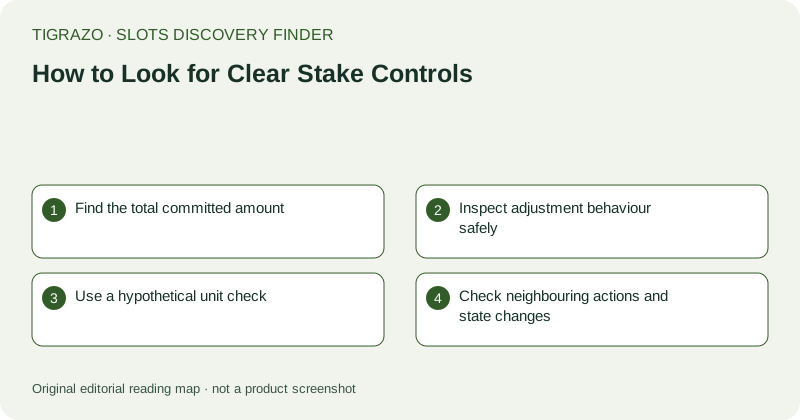
Find the total committed amount
Start by locating the total stake for one ordinary round. A screen may also show coin value, line stake, active lines or another component. Those components are not interchangeable with the final amount. Require a clear relationship between them or a plainly labelled total. A large number can still be ambiguous if its unit is missing. Likewise, a currency symbol does not reveal whether the displayed value is the stake, balance, last payout or optional feature price. Check the label and surrounding context.
Inspect adjustment behaviour safely
Read whether plus and minus controls change the total stake, a denomination or another setting. Check for preset menus and whether selection alone commits anything. Discovery should stay on non-transactional screens; it does not require a paid spin to prove that a number can be adjusted. If a control's effect is unclear, consult its instructions or record the issue as unresolved. Do not repeatedly press unfamiliar controls to learn by trial and error when an adjacent action could initiate spending.
Use a hypothetical unit check
Suppose a hypothetical interface shows twenty lines, a line stake of 0.02 and a total stake of 0.40 currency units. The multiplication is consistent: twenty times 0.02 equals 0.40. Now suppose an optional mode adds 0.10 to the ordinary stake. The relevant committed amount becomes 0.50 only if the rules specify that addition. Your checklist should ask whether the total visibly updates and whether the optional mode is clearly marked. Do not invent a surcharge simply because an unfamiliar icon is selected.
Check neighbouring actions and state changes
A stake control can be readable yet sit beside a confusingly similar paid-action button. Note whether labels distinguish adjustment, confirmation and play. Also check whether entering a feature menu preserves the selected stake or presents a different base amount. Device orientation and zoom may affect visibility, so describe the conditions under which you inspected the screen. A remembered preference is not sufficient evidence of the currently selected amount. Before any transaction, the visible final configuration is what matters, not an earlier note.
Apply a simple shortlist rule
Retain candidates whose essential cost fields are understandable and whose action boundary is documented. Mark partial matches when the total is clear but optional pricing is not. Exclude unresolved candidates if cost clarity is a requirement of the brief. This is an interface-literacy judgement, not an assessment of the game's expected value. Small stakes still create wager volume when repeated, and clear controls do not make outcomes predictable. The discovery result should identify what can be read reliably, under which conditions, and where uncertainty remains.