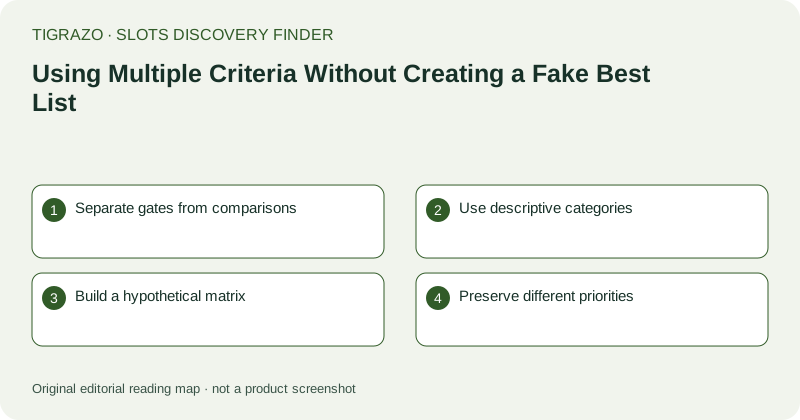
Separate gates from comparisons
A gate is an essential requirement that must be established before a candidate remains under consideration. Clear stake units might be a gate; a preferred visual theme usually is not. Apply gates before comparing optional characteristics. Otherwise a candidate with several attractive extras can appear to compensate for a missing basic requirement. Write the gates in advance and explain their purpose. This is a discovery framework, not a mathematical statement that certain interface traits make a game profitable or appropriate for every reader.
Use descriptive categories
For each criterion, choose labels such as established, partial, absent or unknown. Distinguish absence from lack of evidence: failure to locate a setting does not always prove it does not exist. Add a brief supporting note rather than a made-up score. A number like 8.7 suggests precision and comparability that a casual inspection rarely provides. Descriptive categories are easier to audit because a reader can see whether the evidence actually matches the claim and whether the same standard was used across all candidates.
Build a hypothetical matrix
Imagine a hypothetical brief requiring readable rules and visible total stake, with reduced animation as an optional preference. Candidate A establishes both requirements but leaves animation control unknown. Candidate B establishes visible stake but has unclear award units. Candidate C establishes both requirements and documents a motion setting with limits. A and C can remain for further comparison; B cannot pass the rules gate yet. This example uses invented labels solely to explain the method, not to imply a real inventory, ranking or product endorsement.
Preserve different priorities
If two retained candidates meet all essential criteria, there may be no single correct ordering. One can have clearer layout diagrams while another offers more flexible audio. State those trade-offs in language rather than collapsing them into an unexplained weighted total. If you do use weights for your own organisation, disclose that they reflect the brief's priorities, not objective game quality. Do not treat missing information as an average score or let several minor positives cancel an unresolved cost or rule question.
Publish the reasoning, not a champion
A useful result lists the brief, gates, evidence and remaining questions. It can conclude that two candidates fit different preferences or that none meets every requirement. Avoid best, safest or highest-value labels unless a narrowly defined and genuinely supported comparison warrants them. Feature lists do not establish return distributions, and RTP does not guarantee a session outcome. The purpose of combining criteria is to make a discovery decision understandable and revisable, not to turn browsing into a persuasive recommendation to spend or to keep searching until something can be crowned.